
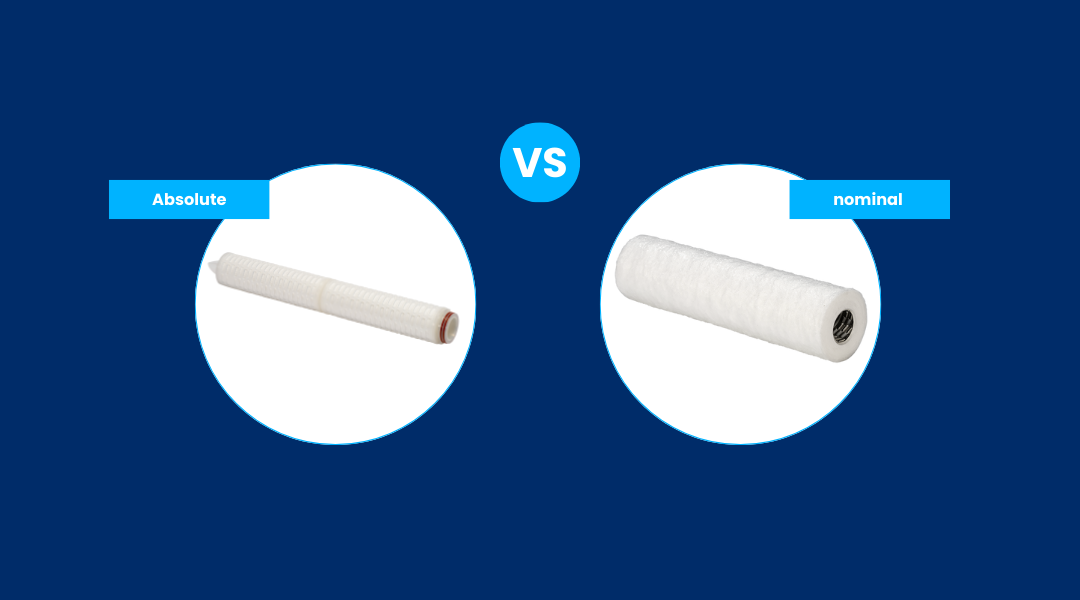
What is the difference between an absolute and a nominal filter?
It’s a question we’re asked regularly by customers in the food & beverage industry as well as in pharmaceuticals. And understandably so — it may seem like a small technical detail, but it has a significant impact on your process performance and final product quality.
That’s why, in this blog, we explain the difference clearly and simply, so you can make the right choice with confidence.
What is an absolute filter?
An absolute filter has a fixed, validated micron rating — for example, 0.2 micron absolute rated.
However, it’s important to also look at the associated Beta ratio, as this value indicates how efficiently the filter retains particles at the specified micron rating.
At Van Borselen Filters, all absolute-rated filters have a Beta 5000 rating.
This means the filter retains at least 99.98% of all particles larger than the stated pore size.
Being aware of the Beta ratio is crucial. Some manufacturers market their filters as “absolute rated,” while they have a Beta ratio of only 1000, resulting in an efficiency of 99.9%. The difference may seem small, but in practice:
Beta 5000 (99.98%) is five times more efficient than Beta 1000 (99.90%).
“Absolute” filters are tested using strict, standardized methods, ensuring predictable and reproducible performance — exactly what you need for critical applications.
Typical applications include:
-
Pharmaceutical production
-
Food & beverage processing
How is a filter tested?
There are several test methods used in the filtration industry, but the most common integrity tests are the Bubble Point Test, Diffusive Flow Test, and Water Intrusion Test (WIT).
- Bubble Point Test
This method is based on the principle that, when a membrane is fully wetted, the pressure required to force a gas bubble through a pore is inversely proportional to the pore diameter. By measuring the pressure at which the first continuous stream of bubbles passes through the filter, the pore size can be determined.
Manufacturers provide a Bubble Point value, allowing users to verify filter integrity using an integrity tester. - Diffusive Flow Test
This test is typically used for hydrophilic membrane filters, such as PES membranes. The filter is fully wetted, and a gas pressure is applied that is lower than the Bubble Point. If the amount of gas diffusing through the membrane remains below the manufacturer’s specified limit, the filter is considered integral.
For example, a 0.2 µm PES membrane filter passes the test if no more than 18 mL of gas per minute per 10" filter length diffuses through at a test pressure of 1800 mbar. Higher values indicate a non-integral filter. - Water Intrusion Test (WIT)
This method is used for hydrophobic membrane filters, typically PTFE membranes. Unlike the other tests, the WIT is performed on a dry filter. A hydrophobic membrane should theoretically allow no water to pass through, so the test measures how much water intrudes under pressure.
For instance, a 0.2 µm PTFE filter is considered integral if no more than 3714 µL of water per 10" filter length intrudes within 10 minutes at a test pressure of 2500 mbar. A higher intrusion volume means the filter is not integral.
View our range of integrity testers:
Microbial retention
One of the most critical functions of filtration is the removal of microbiological contamination to produce sterile liquids. The previously mentioned 0.2 µm membrane filters are considered suitable for sterile filtration in demanding industries such as the (bio)pharmaceutical sector.
Van Borselen Filters’ membrane filters are tested according to the strict ASTM F838 standard. During this test, 1 × 10⁷ Brevundimonas diminuta bacteria per square centimeter of effective filtration area are challenged against the membrane. If all bacteria are retained, the filter is classified as a sterile-grade filter.
In other words: microbiological safety guaranteed.
What is a nominal filter?
A nominal filter provides an approximate indication of filtration performance. Its efficiency typically ranges between 70% and 90%, depending on particle type and flow velocity. This means that up to 30% of particles at the stated micron rating may still pass through the filter.
There is no standardized test method for nominal filters, making their performance less predictable.
Nominal filters are ideal for:
-
Prefiltration
-
Non-critical applications
-
Cost-efficient filtration in temporary or less demanding processes
Making the right choice
Choosing between absolute and nominal filtration depends on:
-
The final product quality you require
-
The nature of your process
-
The sensitivity of downstream equipment
Not sure which option is right for your application? Our specialists are happy to help determine the correct micron rating and filter type. Contact us for full technical specifications.
Learn more? Do you have questions or would you like more information? Fill in your details below, and our team will contact you shortly. We are happy to assist you further!
Contact us