
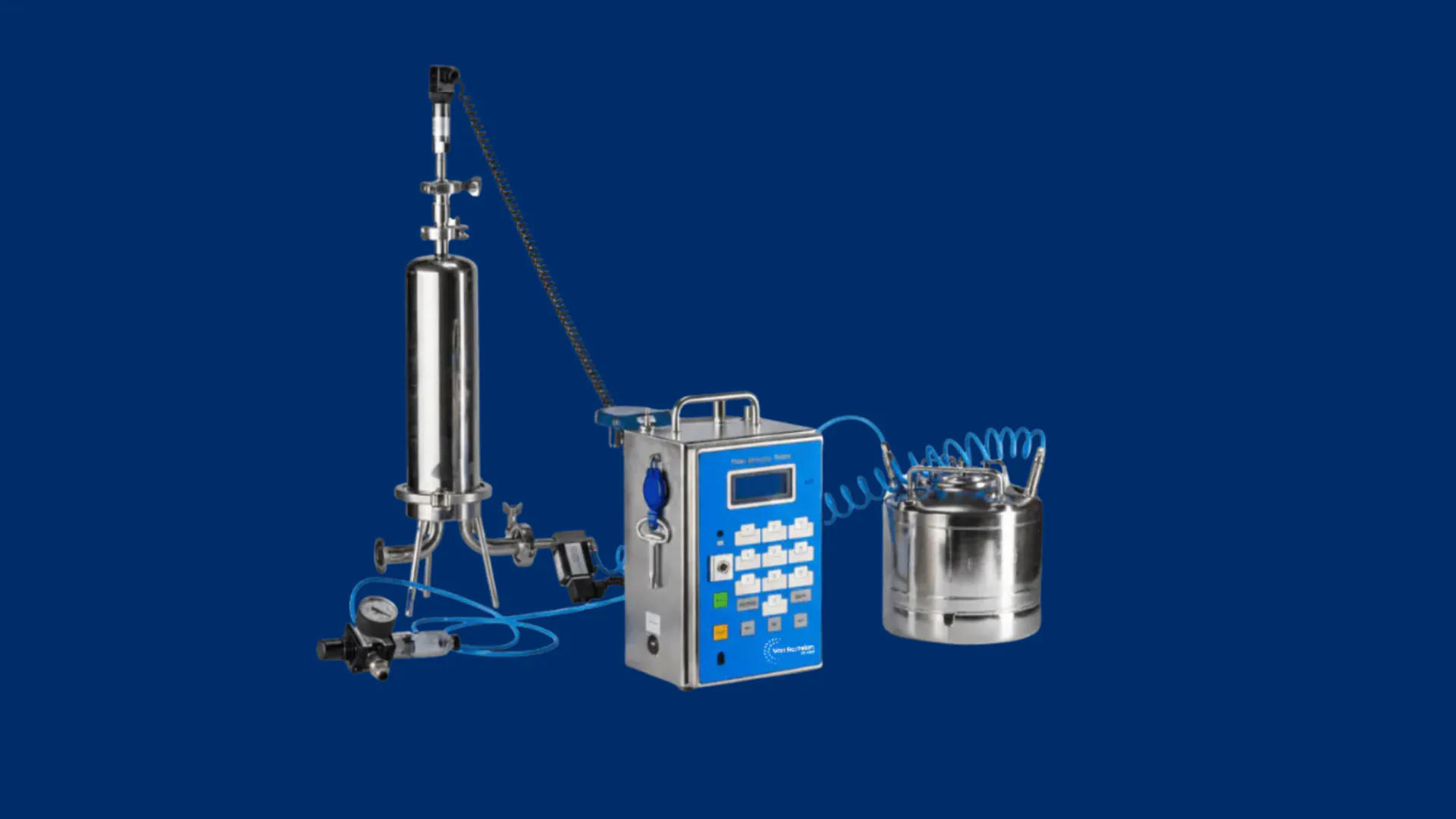
What is a bubble point test?
A bubble point test is a widely used method for verifying the integrity of a membrane filter. This test indirectly determines the largest pore size of the filter. Bubble point testing is mainly applied in critical filtration processes where reliability and safety are essential, such as in the pharmaceutical, biotechnological, and food & beverage industries.
How does a bubble point test work?
The bubble point test is based on a simple physical principle. When a membrane filter is fully wetted, all pores are filled with liquid. To allow gas to pass through a pore, a certain pressure is required to displace the liquid from that pore.
The pressure at which the first continuous stream of gas bubbles passes through the filter is called the bubble point. This pressure is inversely proportional to the pore size:
- High pressure → small pores
- Low pressure → larger pores
By measuring this pressure, it can be determined whether the filter still meets the specified performance requirements.
What is the bubble point test used for?
Manufacturers specify a bubble point value for their filters. By testing the filter with an integrity tester, it can be verified whether the filter:
- is correctly installed
- has no damage
- still meets the required pore size specification
The bubble point test is a non-destructive test method, meaning the filter can remain in use after testing.
Why is bubble point testing important?
Bubble point testing provides a fast and reliable way to verify filter integrity. This helps to:
- prevent product contamination
- ensure process safety
- comply with quality and validation requirements
For this reason, the bubble point test is a standard step in many regulated filtration processes.
A bubble point test is an integrity test for membrane filters that indirectly determines the largest pore size of the filter.
The test measures the pressure at which the first continuous stream of gas bubbles passes through a fully wetted filter. This pressure is inversely proportional to the pore size.
The bubble point value indicates the pressure at which gas can pass through the largest pore of the filter and serves as an indication of pore size and filter integrity.
Learn more? If you would like to receive any additional or specific information about our product range, or if you would like one of our account managers to visit you, please do not hesitate to contact us.
Contact us
A bubble point test is a method used to verify the integrity of a membrane filter by indirectly determining its largest pore size. With a fully wetted filter, the pressure at which the first gas bubbles pass through the filter is measured. The higher the required pressure, the smaller the pore size. This test is widely applied in critical filtration processes, including those in the pharmaceutical and biotechnological industries.