
TFF
Tangential Flow Filtration (TFF), also known as crossflow filtration, is widely used in bioprocessing to separate, concentrate and purify biomolecules. Unlike conventional dead-end filtration, in TFF the process fluid flows parallel to the membrane surface. Smaller components pass through the membrane, while larger molecules are retained.
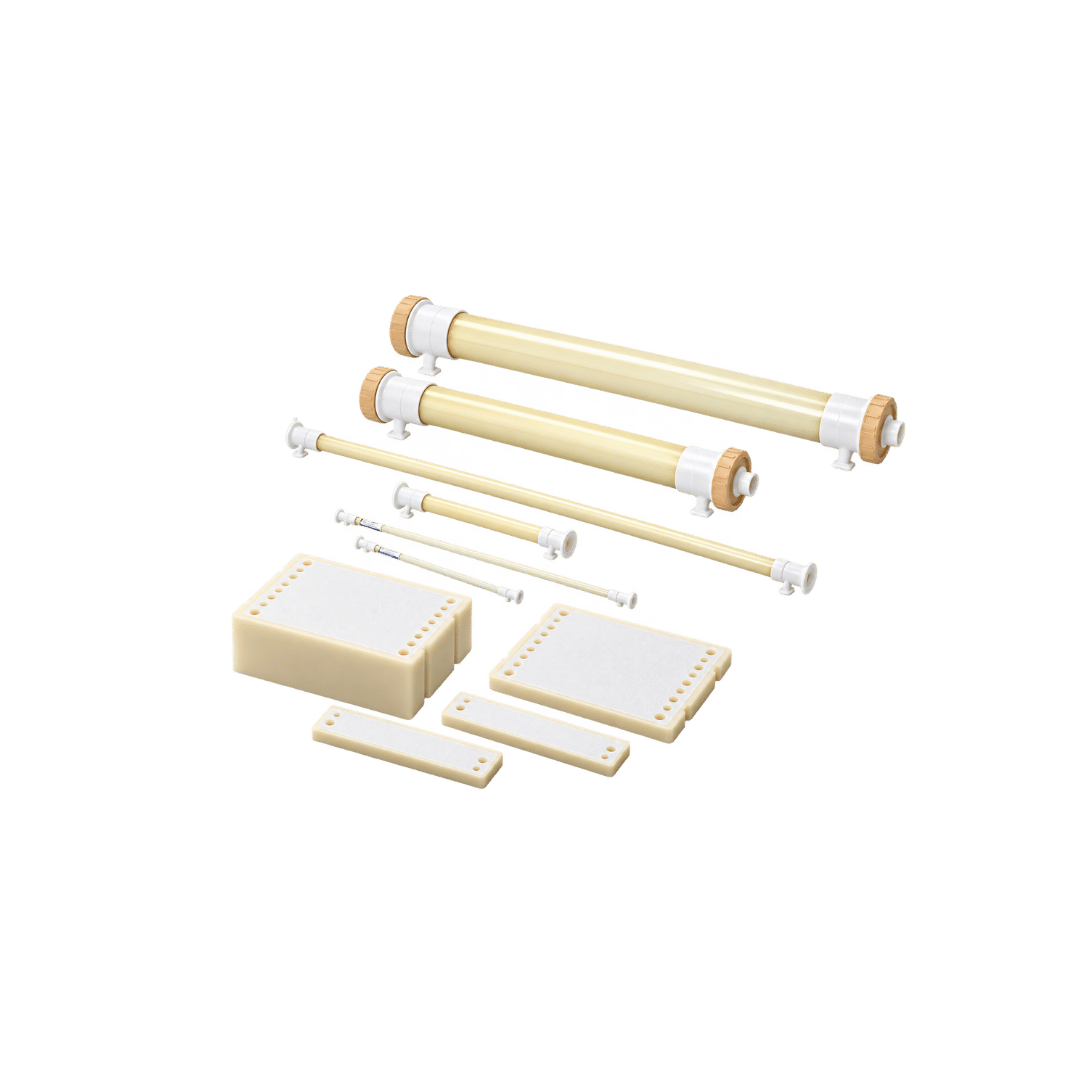
Hollow Fiber TFF for Efficient and Scalable Process Filtration
Hollow Fiber Tangential Flow Filtration (TFF) is a filtration technology used for the separation, concentration and purification of process fluids in biotechnology and pharmaceutical applications. Hollow fiber filters can be used for ultrafiltration (UF), microfiltration (MF), diafiltration (DF), cell harvesting, clarification and buffer exchange.
In tangential flow filtration, the process fluid flows parallel to the membrane surface. Part of the fluid passes through the membrane as permeate, while larger components are retained in the retentate. This tangential flow helps reduce material build-up on the membrane surface and enables an efficient filtration process.
Van Borselen Filters supports companies in selecting the right Hollow Fiber TFF solution for their process. We consider factors such as the application, process fluid, required separation, capacity, membrane properties, pore size or MWCO, and the required scale.
How Does Hollow Fiber TFF Work?
A hollow fiber filter consists of a large number of thin, hollow membrane fibers assembled within a module. The process fluid flows through the fibers, while the membrane determines which components pass through and which are retained in the process stream.
Unlike dead-end filtration, in TFF the fluid flows along the membrane rather than solely perpendicular to it. This principle helps reduce the accumulation of material on the membrane surface.
Hollow fiber membranes also provide an open and linear flow path. This makes the technology particularly suitable for processes involving cells, biomass or shear-sensitive products where gentle and controlled product handling is important.
Microfiltration and Ultrafiltration with Hollow Fiber TFF
Depending on the selected membrane, Hollow Fiber TFF can be used for both microfiltration and ultrafiltration.
In microfiltration, membranes with relatively larger pore sizes are used. This allows cells and larger particles, for example, to be separated from a liquid. Microfiltration is therefore commonly used for applications such as cell harvesting and clarification.
In ultrafiltration, membranes with smaller pore sizes or a specific Molecular Weight Cut-Off (MWCO) are used. Larger molecules can be retained, while smaller components and liquid pass through the membrane.
Selecting the right membrane depends on the product, the required separation and the specific process conditions.
Ultrafiltration and Diafiltration (UF/DF)
An important application of Hollow Fiber TFF is ultrafiltration and diafiltration, commonly referred to as UF/DF.
During ultrafiltration, a product stream can be concentrated by removing liquid and smaller components through the membrane while retaining the desired product.
Diafiltration can subsequently be used to remove small dissolved components from the product stream or to change the composition of the liquid. TFF can therefore also be used for applications such as buffer exchange.
UF/DF is widely used in biotechnology and pharmaceutical manufacturing processes where concentration, purification and buffer exchange are important process steps.
Cell Harvesting and Clarification
Hollow Fiber TFF can also be used for cell harvesting and clarification. In these processes, cells, cellular material or other larger components are separated from the liquid phase.
The open channels of hollow fiber modules enable the processing of streams containing biomass. This makes the technology suitable for various biotechnology processes where efficient separation of cells from the liquid phase is required.
The appropriate hollow fiber configuration depends on factors such as the characteristics of the process stream, biomass concentration, viscosity, required filtration rate and desired separation.
Suitable for Shear-Sensitive Products
Biotechnology and pharmaceutical manufacturing processes often involve products that are sensitive to mechanical stress.
The open and linear flow path of hollow fiber membranes can contribute to gentle and controlled handling of shear-sensitive products. This makes Hollow Fiber TFF particularly suitable for processes involving cells and sensitive biological components.
Proper dimensioning of the TFF process remains essential. Flow rate, pressure, membrane area, membrane properties and module length can all influence overall process performance.
Single-Use and Reusable Hollow Fiber TFF
Depending on the process requirements, either single-use or reusable Hollow Fiber TFF modules can be selected.
Single-use hollow fiber filters are particularly suitable when flexibility, fast product changeovers and reduced cleaning requirements are important. They therefore fit well within modern bioprocessing environments where single-use technologies are increasingly applied.
Cleanable and reusable hollow fiber solutions are also available. The most suitable option depends on the process, production scale and required process configuration.
From Laboratory Scale to Production
Hollow Fiber TFF can be applied at different process scales. During process development, small-scale testing can be used to determine the appropriate membrane, MWCO or pore size and optimal process conditions.
The process can subsequently be scaled up to pilot or production scale. For reliable scale-up, several process parameters should be considered, including membrane area, crossflow, transmembrane pressure (TMP), pressure drop, product concentration and process volume.
Van Borselen Filters can support you in selecting and sizing a Hollow Fiber TFF solution that matches your application and required process scale.
Selecting the Right Hollow Fiber TFF Solution
There is no single hollow fiber filter suitable for every application. Selecting the right solution therefore always starts with understanding the process.
Important factors include the application, required pore size or MWCO, properties of the process fluid, presence of cells or biomass, required capacity, membrane area, process pressure, flow rate and the choice between a single-use or reusable solution.
By evaluating these factors together, a TFF solution can be selected based on the complete process rather than on an individual filter specification alone.
Hollow Fiber TFF for Biotechnology and Pharmaceutical Applications
Within biotechnology and pharmaceutical processes, Hollow Fiber TFF can be used for various process steps. These include cell harvesting and clarification for separating cells from liquids, ultrafiltration for concentrating a product, and diafiltration for removing or exchanging smaller dissolved components.
This versatility allows the same filtration technology to be used for different applications, from process development through to production.
Van Borselen Filters supports customers with filtration and separation challenges and helps select the right solution for their specific process.