
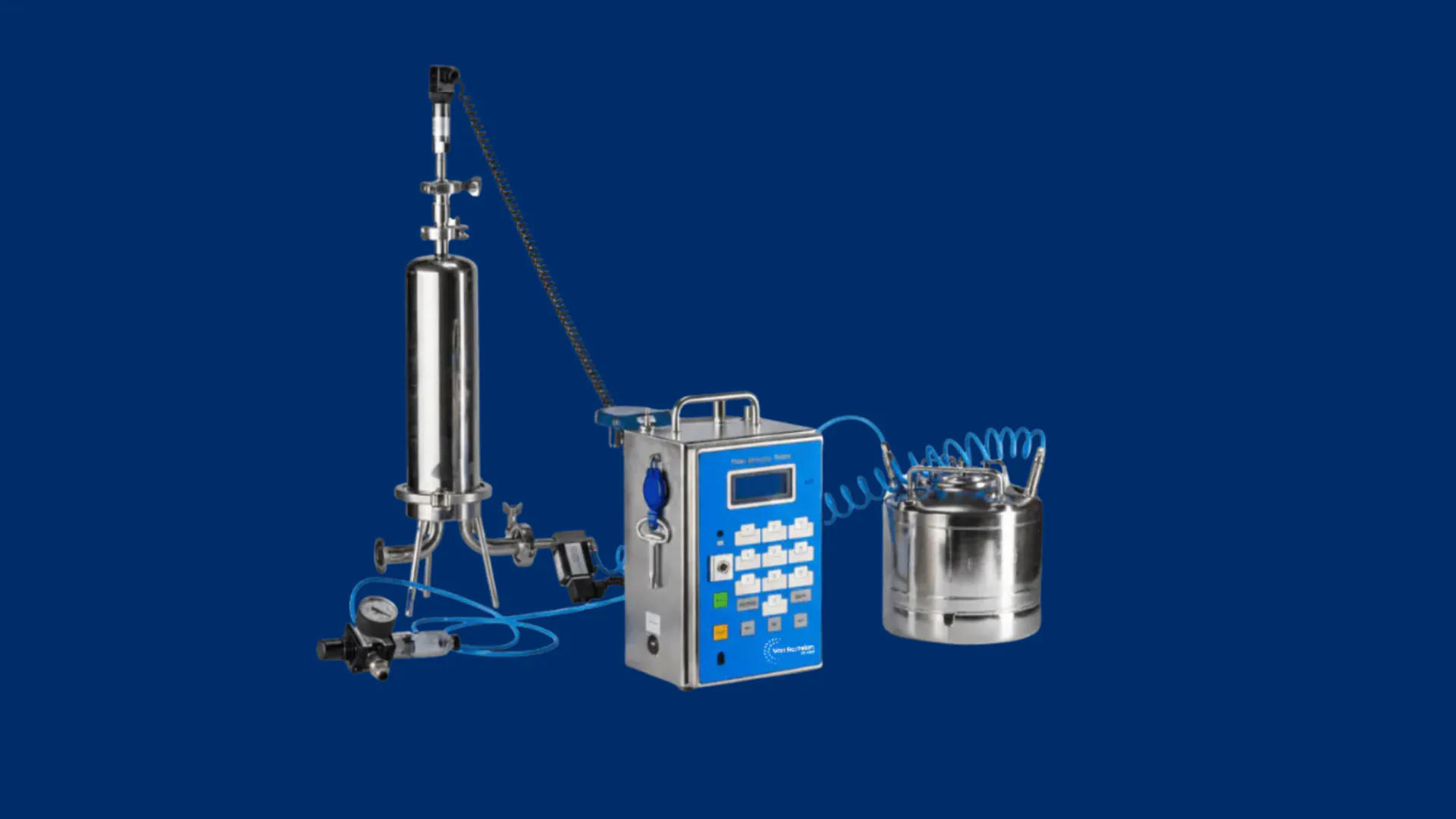
In critical applications within the pharmaceutical and biotechnological industries, filter integrity is essential. One widely used method to verify the integrity of hydrophilic membrane filters is the Diffusive Flow Test (DFT).
This test is primarily applied to hydrophilic membrane filters, such as PES (polyethersulfone) membrane filters, which are commonly used for the sterile filtration of aqueous solutions.
In this blog, we explain clearly and in a technically accurate way what the Diffusive Flow Test is, how it works, and why it is crucial in GMP environments.
What is a Diffusive Flow Test?
The Diffusive Flow Test (DFT) is a non-destructive integrity test for membrane filters. The test verifies whether the membrane is intact and whether the pore structure still meets the manufacturer’s specifications.
The test is based on gas diffusion through a fully wetted membrane.
How does it work?
The procedure typically consists of the following steps:
- The membrane filter is fully wetted with a suitable liquid (usually water or an aqueous medium).
- A defined gas pressure is then applied to the filter.
- This test pressure is set below the Bubble Point value.
- The gas that diffuses through the wetted membrane is measured.
- The measured gas flow (diffusive flow) is compared with the maximum allowable value specified by the manufacturer.
If the measured value remains below the limit, the filter is considered integral and passes the test.
If the value exceeds the limit, the membrane may be damaged or defective.
Practical example (0.2 µm PES membrane filter)
For a 0.2 µm PES membrane filter, the following specifications may apply:
- Test pressure: 1,800 mbar
- Maximum diffusive flow: 18 mL/min per 10” filter length
If, at 1,800 mbar, less than 18 mL of gas per minute per 10” filter length is measured, the filter is considered intact and passes the test.
If more than 18 mL/min is measured, the filter is not integral and must not be released for use.
What does the Diffusive Flow Test measure exactly?
The test measures the amount of gas that diffuses through a liquid-filled membrane via dissolved gas molecules.
Because the pores are filled with liquid:
- no bulk gas flow can occur
- only molecular diffusion is measured
- the measured value is highly sensitive to membrane damage
Even a small crack or enlarged pore will immediately result in increased gas flow, causing the test to fail.
Difference between the Diffusive Flow Test and the Bubble Point Test
Although both are integrity tests, they measure different phenomena:
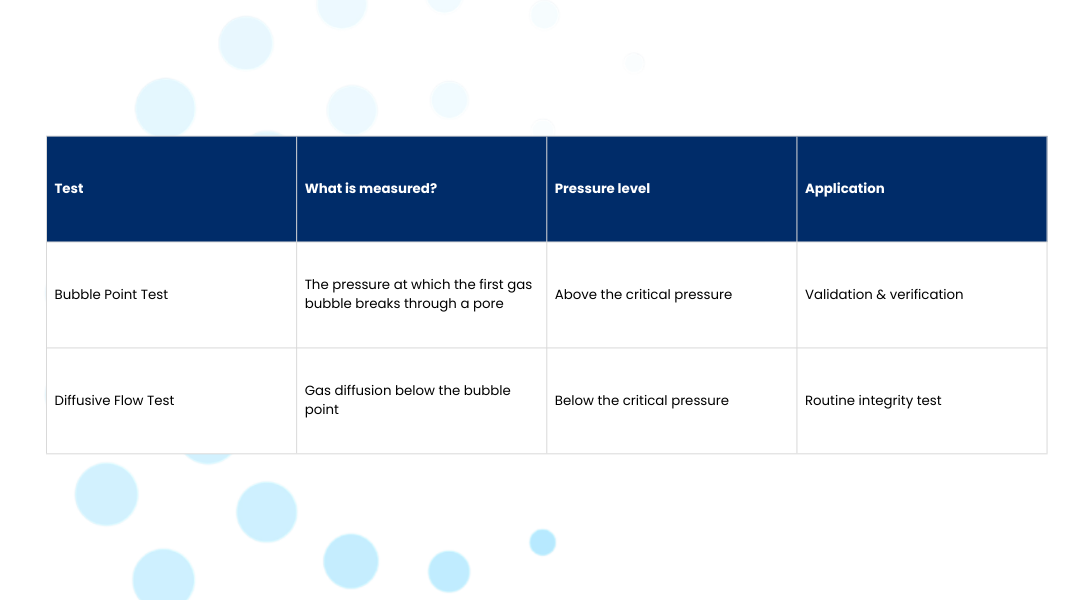
In practice, the Diffusive Flow Test is often used as a routine integrity test, as it is faster, highly reproducible, and easy to automate using an integrity testing system.
Want to learn more about Bubble Point Testing?
The Diffusive Flow Test is often compared to the Bubble Point Test, but both are based on different physical principles of filter integrity. While the Diffusive Flow Test measures gas diffusion below the critical pressure, the Bubble Point Test determines the pressure at which the first continuous gas bubble breaks through a fully wetted membrane.
Would you like to understand exactly how the Bubble Point Test works, when to apply it, and how it differs from Diffusive Flow Testing?
Then also read our in-depth blog on Bubble Point Testing, where we explain the operation and interpretation step by step.
Read everything about Bubble Point Testing
Why is the Diffusive Flow Test so important in the pharmaceutical industry?
Within GMP environments, it must be demonstrably proven that:
- the sterile filter is free from defects
- the process is safe and reproducible
- batch release is supported by validated test results
The Diffusive Flow Test provides:
✔️ Reliable verification of 0.2 µm sterilizing-grade filters
✔️ Non-destructive test method
✔️ Fast execution (before and/or after filtration)
✔️ Complete documentation for audit and validation purposes
When do you perform a Diffusive Flow Test?
In most cases, the test is performed:
- Before use (pre-use integrity test)
- After use (post-use integrity test)
- During validation of new filter types
Pre-use testing is especially important in critical pharmaceutical applications where absolute assurance is required.
For hydrophilic membrane filters, such as PES, cellulose ester, and certain PVDF membranes used with aqueous liquids.
Yes. Incomplete wetting leads to inaccurate test results.
Because the test is designed to measure diffusion only, not bulk gas breakthrough.
The allowable gas flow depends on the membrane surface area. Longer filters have a higher permissible limit.
Learn more? Do you have questions or would you like more information? Fill in your details below, and our team will contact you shortly. We are happy to assist you further!
Contact us
The Diffusive Flow Test (DFT) is a non-destructive integrity test for hydrophilic membrane filters such as 0.2 µm PES filters. By measuring gas diffusion below the bubble point pressure, it verifies whether the filter is intact. A critical test for sterile filtration in GMP environments.