
Integrity testers Practical guide for determining hardware volume and performing a WIT test on hydrophobic PTFE membrane filters.What is the Water Intrusion Test and when is it used?
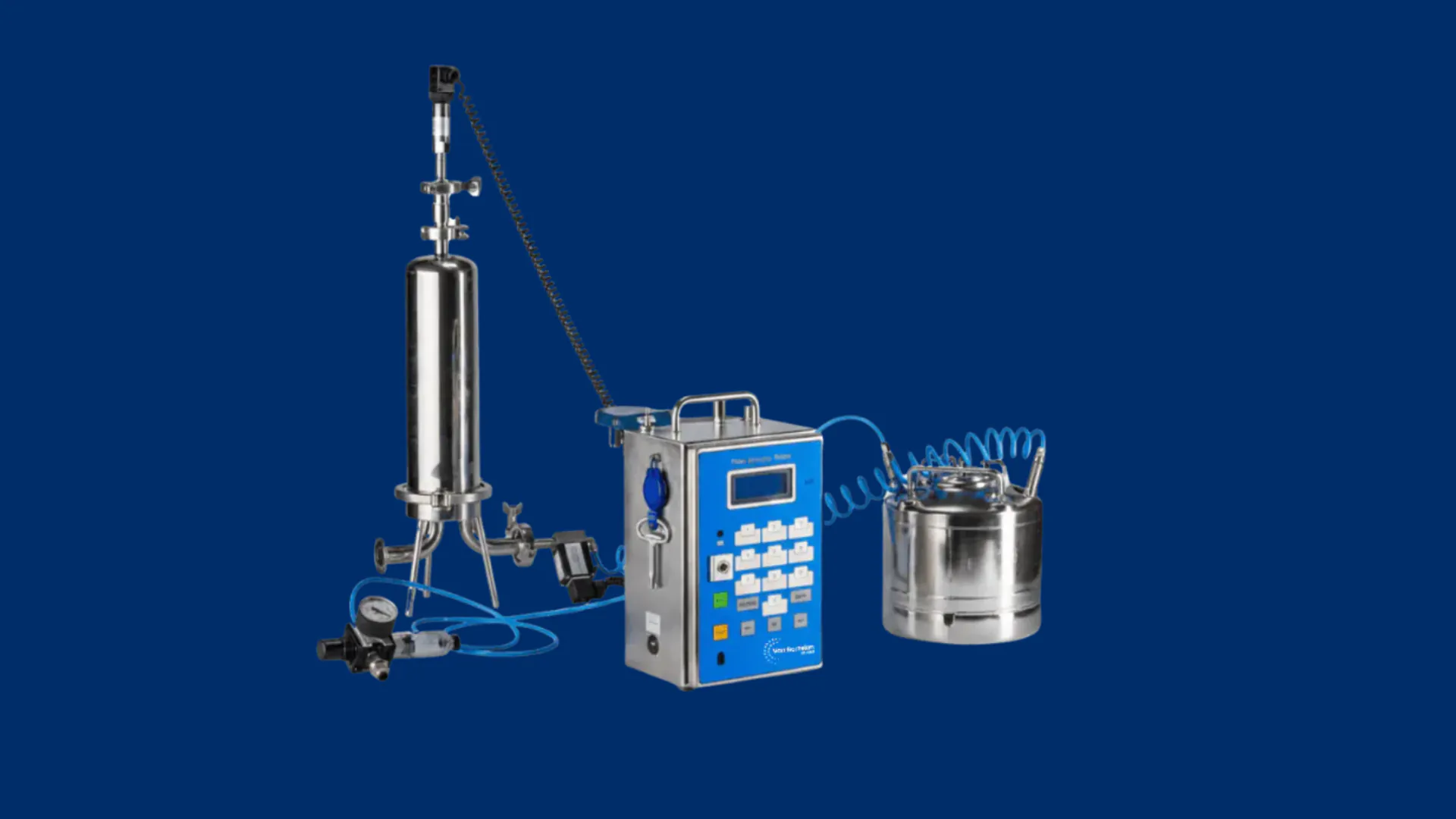
Within sterile gas filtration and venting applications, hydrophobic membrane filters are commonly used, particularly PTFE membrane filters. To verify the integrity of these filters, the Water Intrusion Test (WIT) is applied.
The WIT is specifically developed for hydrophobic membranes and operates on a fundamentally different principle than the Diffusive Flow Test or the Bubble Point Test.
What is a Water Intrusion Test?
The Water Intrusion Test (WIT) is a non-destructive integrity test for hydrophobic membrane filters, most commonly PTFE.
In contrast to tests for hydrophilic membranes:
- the filter is tested dry
- no full wetting is performed
- the test measures how much water intrudes into the membrane under pressure
Because a hydrophobic membrane repels water, theoretically little to no water should penetrate the membrane. The test therefore verifies whether the water intrusion remains below the specified limit.
How does the Water Intrusion Test work?
- The PTFE filter remains dry
- Water is applied to the upstream side of the filter
- A defined test pressure is set (for example, 2,500 mbar)
- Over a fixed period (for example, 10 minutes), the amount of water that penetrates the membrane is measured
Evaluation of the test:
- The measured value is compared with the maximum limit specified by the manufacturer
- If the measured water intrusion remains below the limit, the filter is considered integral
- If the limit is exceeded, the membrane may be damaged or contain enlarged pores
Practical example (0.2 µm PTFE filter)
For a 0.2 µm PTFE membrane filter, the following parameters may apply:
- Test pressure: 2,500 mbar
- Test duration: 10 minutes
- Maximum water intrusion: 3,714 µL per 10” filter length
If, at 2,500 mbar, a maximum of 3,714 µL of water per 10-inch filter length passes through the membrane within 10 minutes, the filter is considered intact.
If more water is allowed to pass, the filter fails the integrity test.
Why does the WIT only work for hydrophobic membranes?
Hydrophobic materials such as PTFE:
- repel water
- have a high contact angle
- do not allow water to pass under normal conditions
When a membrane is damaged or contains enlarged pores, water can penetrate under pressure. The Water Intrusion Test detects this with high sensitivity.
For this reason, WIT is particularly suitable for:
- Sterile gas filtration
- Tank venting
- Air filtration in pharmaceutical environments
- Vent filters
Difference between WIT and other integrity tests
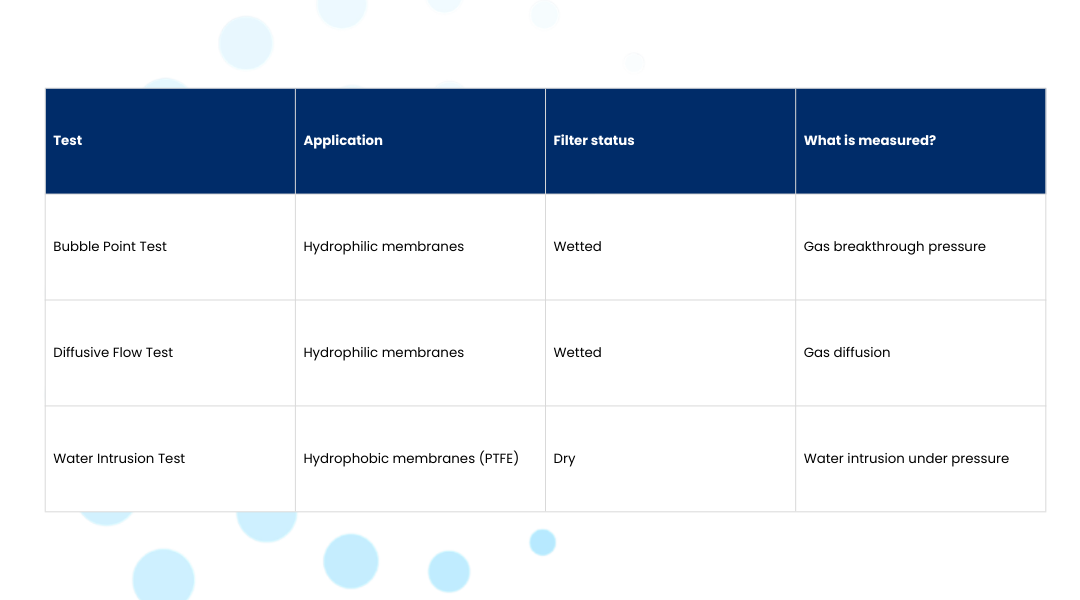
The choice of the integrity test therefore fully depends on the membrane material.
Why is WIT important in GMP environments?
Within pharmaceutical manufacturing processes, it must be demonstrated that:
- gas filters are free from defects
- contamination via tank venting is prevented
- sterile barriers remain intact
The Water Intrusion Test provides:
✔ Reliable integrity verification of PTFE gas filters
✔ A fully non-destructive test method
✔ Suitable for routine testing
✔ Documentable results for audits and batch release
Want to learn more about other integrity tests?
The Water Intrusion Test is specifically used for hydrophobic PTFE membrane filters. However, depending on the membrane material and the application, a different integrity test may be required.
For hydrophilic membrane filters, such as 0.2 µm PES filters, the Diffusive Flow Test (DFT) is most commonly used. This test measures gas diffusion below the bubble point pressure and is widely applied in sterile liquid filtration.
In addition, there is the Bubble Point Test, which determines the pressure at which the first continuous gas bubble breaks through a fully wetted membrane. This test is often used during validation or as an additional verification of filter integrity.
Would you like to clearly understand:
- when to apply WIT
- when Diffusive Flow Testing is the right choice
- and when Bubble Point Testing is required
Then also read our in-depth blogs:
Read more about Diffusive Flow Testing
Read more about Bubble Point Testing
No. WIT is only suitable for hydrophobic membranes such as PTFE.
Because hydrophobic membranes repel water. That specific property is exactly what the test is designed to verify.
The allowable water intrusion depends on the membrane surface area. Larger filters have higher permissible limits.
No. It is a validated membrane integrity test specifically designed for hydrophobic filters.
Learn more? Do you have questions or would you like more information? Fill in your details below, and our team will contact you shortly. We are happy to assist you further!
Contact us
The Water Intrusion Test (WIT) is the integrity test for hydrophobic PTFE membrane filters. By measuring how much water penetrates the dry membrane under pressure, it accurately determines whether the filter is intact. For sterile gas filtration and tank venting within the pharmaceutical industry, WIT is an essential quality control step in GMP processes.